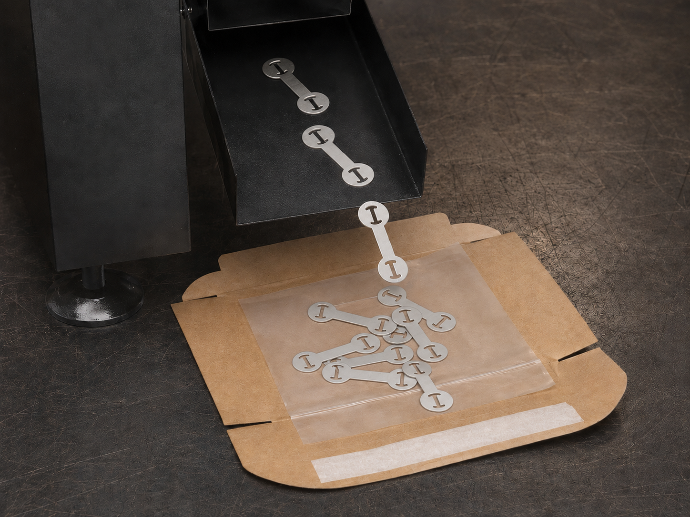
Why avoid rolls and loose packing
0.15 mm pure nickel tabs and connectors are thin. Even though the material is metal, a cut part with openings, bridges or narrow outputs can deform during transport. A roll or loose packing can mark parts, bend thin areas or make inspection harder on arrival.
The issue is not only appearance. A bent part can take longer to position, be harder to weld and be less useful when comparing the received part with the original DXF.
Principle of flat shipping
Thin parts should be protected in a rigid cardboard envelope, with flat support to limit movement. The goal is to preserve the general shape, avoid accidental bending and make reception in the workshop easier.
Nickel Tabs does not treat these parts like bulk metal strip. The point is to receive clean, flat, usable pieces, without rolls, without loose packing and without unnecessary deformation before assembly.
For small batches, flat shipping matches the use case: prototypes, samples, assembly tests, validation parts, occasional replacement and pre-series.
What the packaging should protect
The packaging must protect the geometry, not only the surface. A thin nickel part can include narrow bridges, holes, slots, long outputs or multiple small pieces in the same order. These details need to arrive readable and usable.
- Thin bridges.
- Internal cut-outs.
- Current outputs.
- Large flat parts.
- Multiple small parts.
- Narrow or fragile geometry.
- Surfaces that should stay clean for handling.
- Parts that need to be compared with the DXF on arrival.
Prepare workshop reception
On receipt, it is useful to check the parts before assembly: quantity, general shape, thin areas, possible transport marks and match with the ordered DXF version. If a shape needs to be ordered again, keeping the validated file helps avoid confusion.
A clean reception workflow saves time. The workshop can check the part, compare it with the drawing, test the fit on the assembly and decide whether the geometry is ready for use, adjustment or a small reorder.
Flat shipping is part of the service logic: fast production, controlled geometry, protected pieces and delivery across Europe without treating thin nickel parts as loose material.
Before shipping, make sure the DXF describes the final part to produce.
Read the DXF preparation guide→